

Introduction
Many customers notice that wood pressed oil is priced higher than refined oil. This often leads to the question: Why does wood pressed oil cost more?
Understanding the difference in extraction methods, production scale, and processing explains the price gap clearly. The cost difference is not random — it reflects how the oil is produced.
1️⃣ Extraction Method: Slow vs Industrial Speed
The biggest difference lies in how the oil is extracted.
Wood Pressed Oil:
- Extracted using traditional wooden press (chekku)
- Slow rotational speed
- Mechanical pressing
- Small-batch production
Refined Oil:
- Often solvent extracted using industrial chemicals
- High-speed processing
- Large-scale automated production
Wood pressing takes more time and produces less oil per hour compared to industrial extraction. Lower production speed increases cost.
2️⃣ Lower Oil Yield in Wood Pressing
Industrial solvent extraction extracts maximum oil from seeds.
Wood pressing focuses on mechanical extraction and may produce slightly lower yield compared to chemical solvent extraction.
Lower yield + slower extraction = higher production cost.
3️⃣ No Chemical Solvent Extraction
Refined oil manufacturing often uses chemical solvents (like hexane) to maximize oil recovery. This process is efficient and cost-effective at scale.
Wood pressed oil avoids:
- Solvent extraction
- Chemical neutralization
- Bleaching
- Deodorizing
Skipping these industrial processes reduces large-scale efficiency but maintains minimal processing. This affects pricing.
4️⃣ Small Batch Production
Most wood pressed oil producers operate in smaller units compared to massive industrial refineries.
Industrial refineries:
- Process tons of seeds daily
- Operate with automation
- Reduce per-unit cost
Wood pressed oil units:
- Operate in limited capacity
- Often batch-based
- Have higher per-unit production cost
Economies of scale strongly favor refined oil production.
5️⃣ Natural Processing Without Deodorizing
Refined oil undergoes:
- High heat deodorizing
- Color correction
- Uniform texture adjustment
These steps standardize oil for mass market use.
Wood pressed oil retains natural aroma and original characteristics. This limits industrial optimization but preserves traditional identity.
6️⃣ Raw Material Quality
Many wood pressed oil brands focus on:
- Selected raw seeds
- Cleaner batches
- Smaller procurement quantities
Industrial refined oil production often focuses on volume and large procurement chains.
Quality sourcing at smaller scale typically increases cost.
7️⃣ Packaging and Storage Differences
Wood pressed oils are often:
- Packed in smaller batches
- Stored carefully
- Marketed as premium products
Refined oils are produced in massive quantities and distributed widely, reducing packaging cost per unit.
8️⃣ Market Positioning
Refined oil is positioned as:
- Affordable
- Mass-market
- Highly processed and neutral
Wood pressed oil is positioned as:
- Traditional
- Minimally processed
- Premium segment
Premium positioning naturally comes with higher pricing.
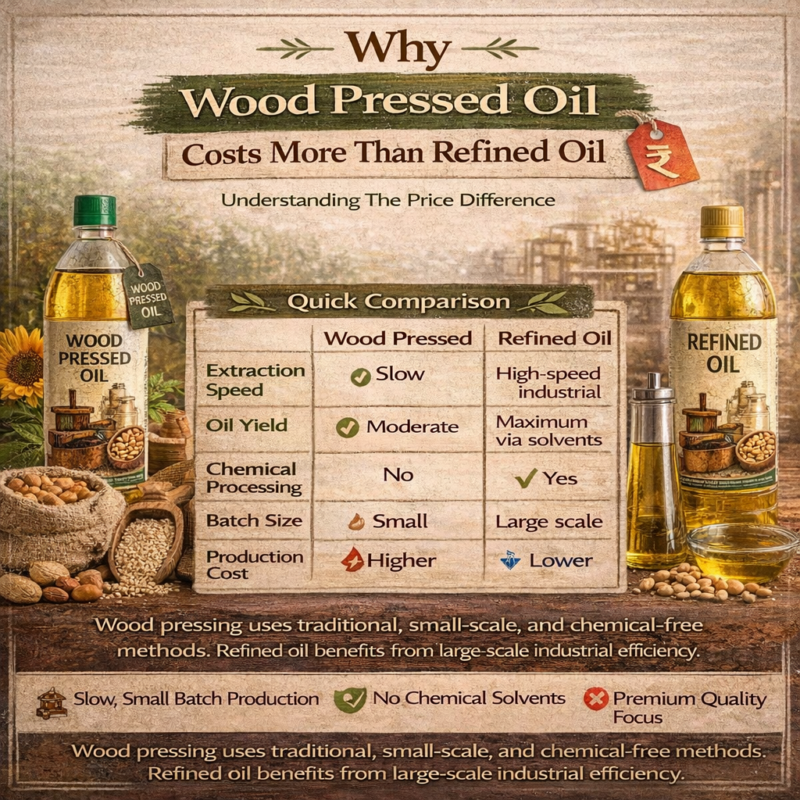
Quick Comparison: Why Price Differs
| Factor | Wood Pressed Oil | Refined Oil |
|---|---|---|
| Extraction Speed | Slow | High-speed industrial |
| Oil Yield | Moderate | Maximum via solvents |
| Chemical Processing | No | Yes |
| Batch Size | Small | Large scale |
| Production Cost | Higher | Lower |
Does Higher Cost Automatically Mean Better?
Not necessarily.
The price reflects:
- Production method
- Processing level
- Scale of operation
Some consumers prefer minimal processing and natural aroma. Others prioritize affordability and neutral flavor.
The choice depends on individual priorities.
Why Some Consumers Still Choose Wood Pressed Oil
Consumers who choose wood pressed oil often value:
- Traditional extraction method
- Natural aroma
- Avoidance of solvent extraction
- Minimal processing
For them, the higher price aligns with their preferences.
Final Thoughts
Wood pressed oil costs more than refined oil because of slower extraction, smaller production scale, lower yield, and avoidance of industrial chemical processes.
Refined oil benefits from large-scale efficiency and solvent extraction, making it more affordable.
The price difference reflects processing method and production scale — not just branding.
Understanding this helps you choose oil based on value perception rather than just cost.
