

Introduction
Many consumers today are questioning how their cooking oil is produced. One of the most common questions is: Is refined oil chemically processed?
Understanding how refined oil is manufactured helps you make more informed decisions about the oils you use for daily cooking. This article explains the refining process in simple terms and compares it with traditional wood pressed oil extraction.
What Is Refined Oil?
Refined oil refers to cooking oil that has undergone industrial processing to improve:
- Shelf life
- Color
- Texture
- Neutral flavor
Refining is done to remove impurities, odor, and free fatty acids from crude oil extracted from seeds.
Common refined oils include:
- Refined sunflower oil
- Refined groundnut oil
- Refined soybean oil
- Refined palm oil
How Is Refined Oil Produced?
The production of refined oil usually involves multiple steps.
1️⃣ Solvent Extraction
In large-scale industrial production, oil seeds are often processed using chemical solvents (commonly hexane) to extract maximum oil content.
This is done because solvent extraction yields more oil compared to mechanical pressing.
After extraction, the solvent is removed during later stages.
2️⃣ Degumming
This process removes natural gums and phospholipids from the oil.
3️⃣ Neutralization
Free fatty acids are removed using chemical agents to improve stability and taste.
4️⃣ Bleaching
Bleaching agents are used to remove color pigments and impurities.
5️⃣ Deodorizing
The oil is heated at high temperatures to remove odor and flavor, resulting in neutral-smelling oil.
So, Is Refined Oil Chemically Processed?
Yes — most refined oils undergo chemical processing steps, particularly during solvent extraction and neutralization stages.
However, it is important to understand:
- The chemicals used are part of industrial refining
- The final product is filtered and processed for commercial sale
- Refined oil is widely used in large-scale food industries
Refining is done to create stable, odorless oil suitable for mass consumption.
Why Is Refined Oil Processed This Way?
Refining serves several purposes:
- Increases shelf life
- Creates uniform appearance
- Removes strong natural odors
- Allows high-volume industrial production
Without refining, oil may have:
- Strong smell
- Shorter storage life
- More variation in color
Industrial refining focuses on consistency and large-scale production.
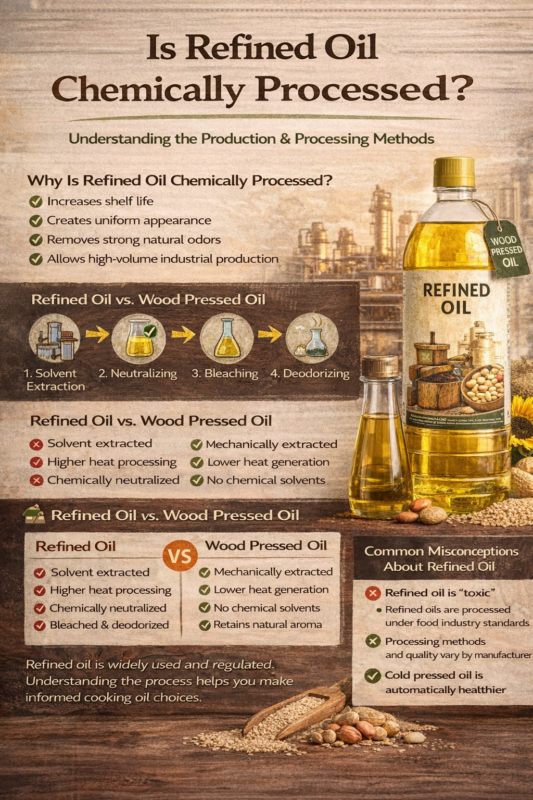
Refined Oil vs Wood Pressed Oil
Here’s where the real difference lies.
Refined Oil:
- Often solvent extracted
- High heat processing
- Chemically neutralized
- Deodorized
Wood Pressed Oil:
- Mechanically extracted
- Lower heat generation
- No chemical solvents
- Retains natural aroma
Wood pressed oil emphasizes minimal processing, while refined oil emphasizes industrial efficiency.
Does Chemical Processing Make Refined Oil Unsafe?
Refined oil is regulated for commercial sale and widely consumed worldwide. The refining process is designed to remove impurities and produce stable oil.
However, some consumers prefer minimally processed oils because they:
- Avoid solvent extraction
- Avoid bleaching and deodorizing
- Retain natural aroma
The choice depends on personal preference and cooking priorities.
Why Some People Avoid Refined Oils
Consumers who prefer wood pressed or cold pressed oils often do so because:
- They want less industrial processing
- They prefer natural aroma and taste
- They prefer traditional extraction methods
It is less about fear and more about processing transparency.
Common Misconceptions About Refined Oil
Myth: Refined oil is “toxic.”
Reality: Refined oils are processed under food industry standards.
Myth: All refined oils are the same.
Reality: Processing methods and quality vary by manufacturer.
Myth: Cold pressed oil is automatically healthier.
Reality: The key difference lies in processing method, not automatic health claims.
Final Thoughts
Refined oil is typically chemically processed as part of industrial production methods. This includes solvent extraction, neutralization, bleaching, and deodorizing.
In contrast, wood pressed oil uses mechanical extraction with minimal processing.
Understanding the difference helps you make a choice based on:
- Processing preference
- Cooking needs
- Flavor expectations
- Brand transparency
The key is awareness, not marketing hype.
